From Predictive Maintenance to Smarter Decisions: How AI Is Changing Hotel Operations

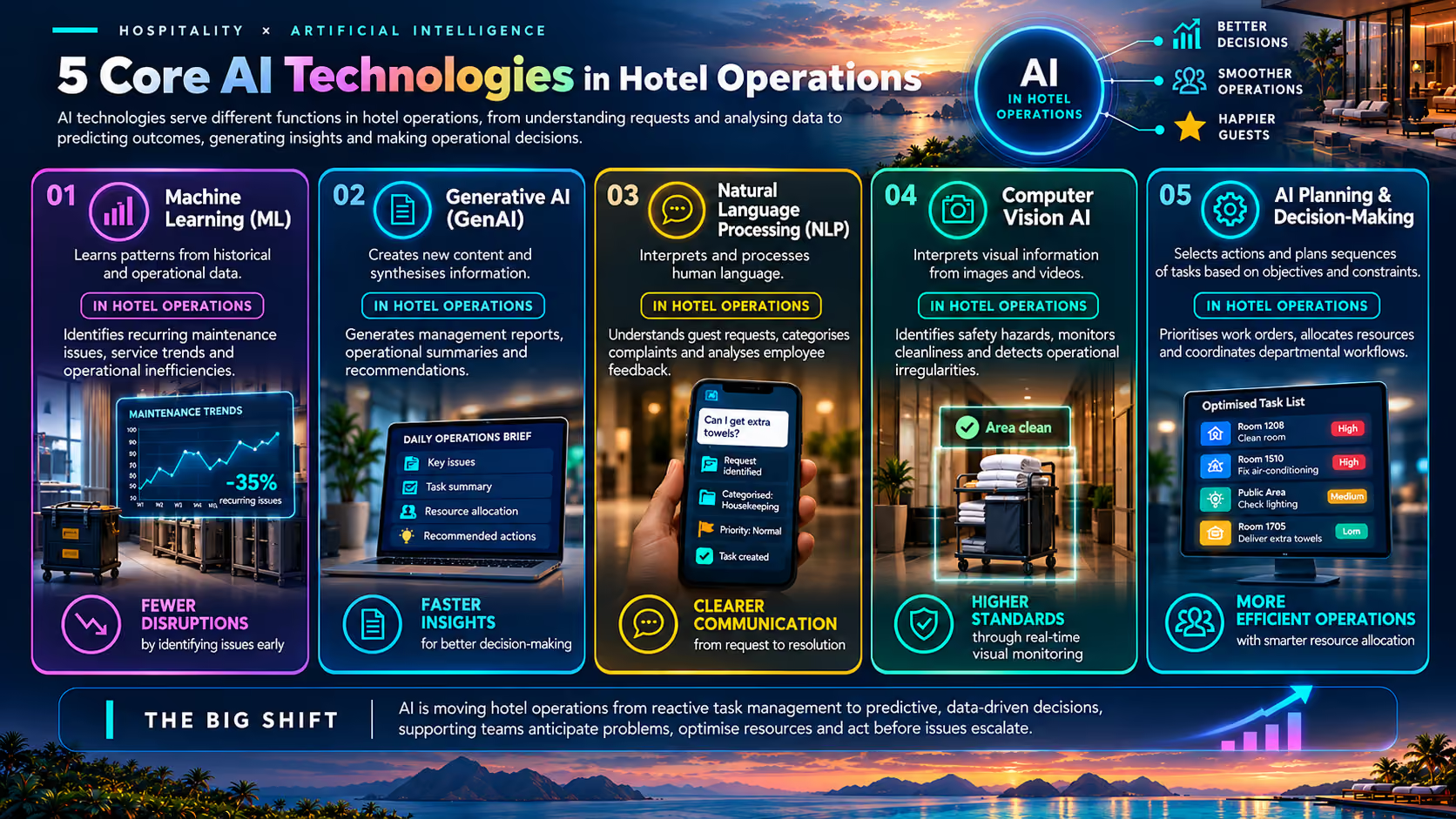
From anticipating equipment failures before they occur to understanding guest requests in real time, artificial intelligence (AI) is changing how hotels manage daily operations.
Hotel teams are increasingly looking beyond manual processes and reactive task management. With AI, they can analyze operational data, spot potential issues earlier, automate routine tasks, and make better decisions about how resources are used.
Five core AI technologies are driving this shift in hotel operations: Machine Learning (ML), Generative AI (GenAI), Natural Language Processing (NLP), Computer Vision AI, and AI Planning & Decision-Making.
Each plays a different role, from recognizing patterns and interpreting information to predicting outcomes and coordinating operational tasks.
1. Machine Learning (ML): Anticipating Issues Before They Escalate
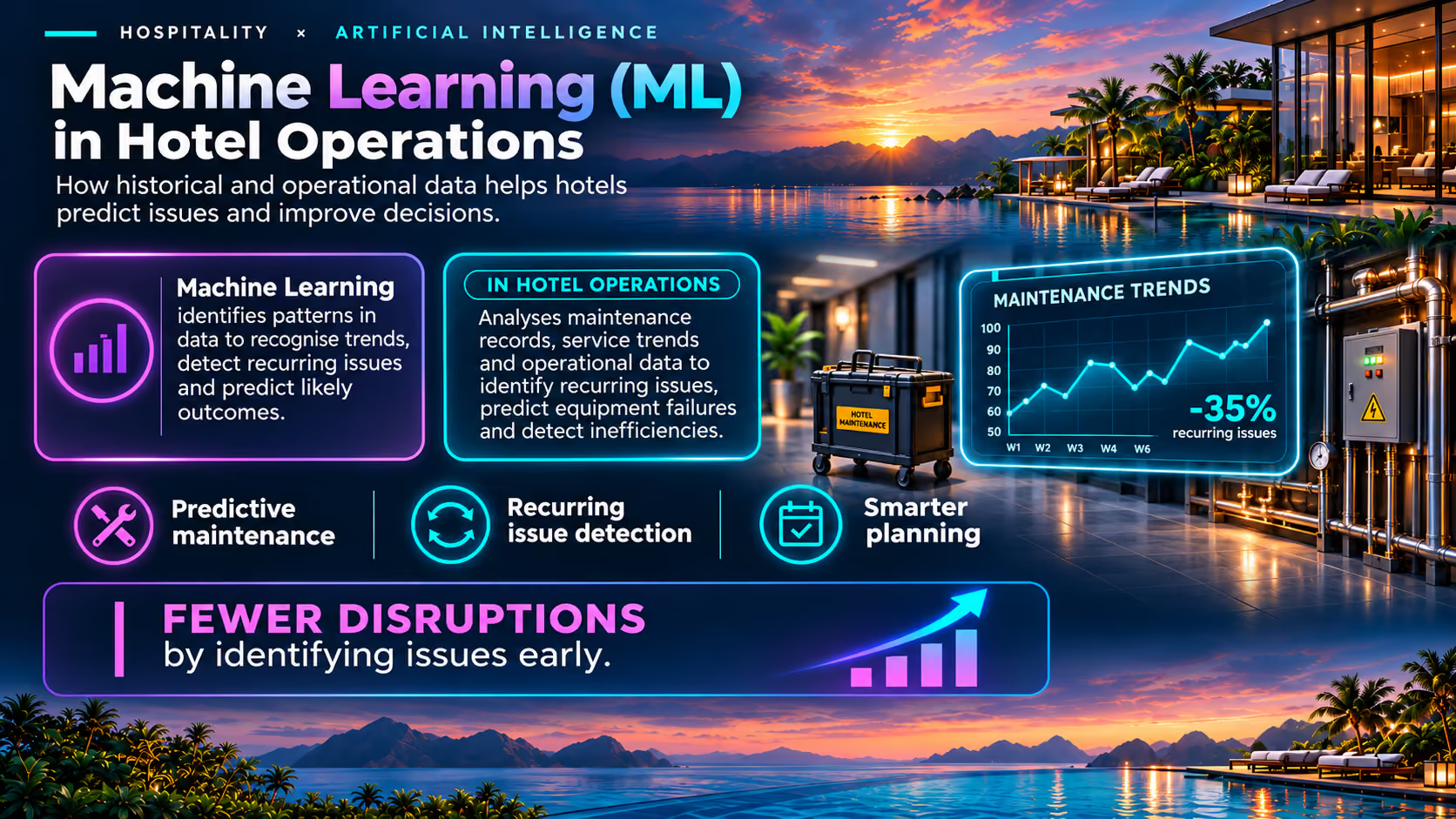
Machine Learning helps hotels recognize patterns in historical and operational data, enabling them to identify recurring issues, service trends, and potential inefficiencies.
In hotel maintenance, ML can analyze equipment performance and maintenance records to detect patterns associated with recurring faults or possible equipment failures.
For engineering teams, this means having more information to plan preventive maintenance activities, address potential problems earlier and reduce unexpected disruptions.
The same technology can also support demand forecasting, resource planning, and the analysis of operational performance. By identifying patterns that might otherwise go unnoticed, Machine Learning helps hotel teams make decisions based on what could happen next, rather than relying only on what has already happened.
2. Generative AI (GenAI): Turning Operational Data into Actionable Insights
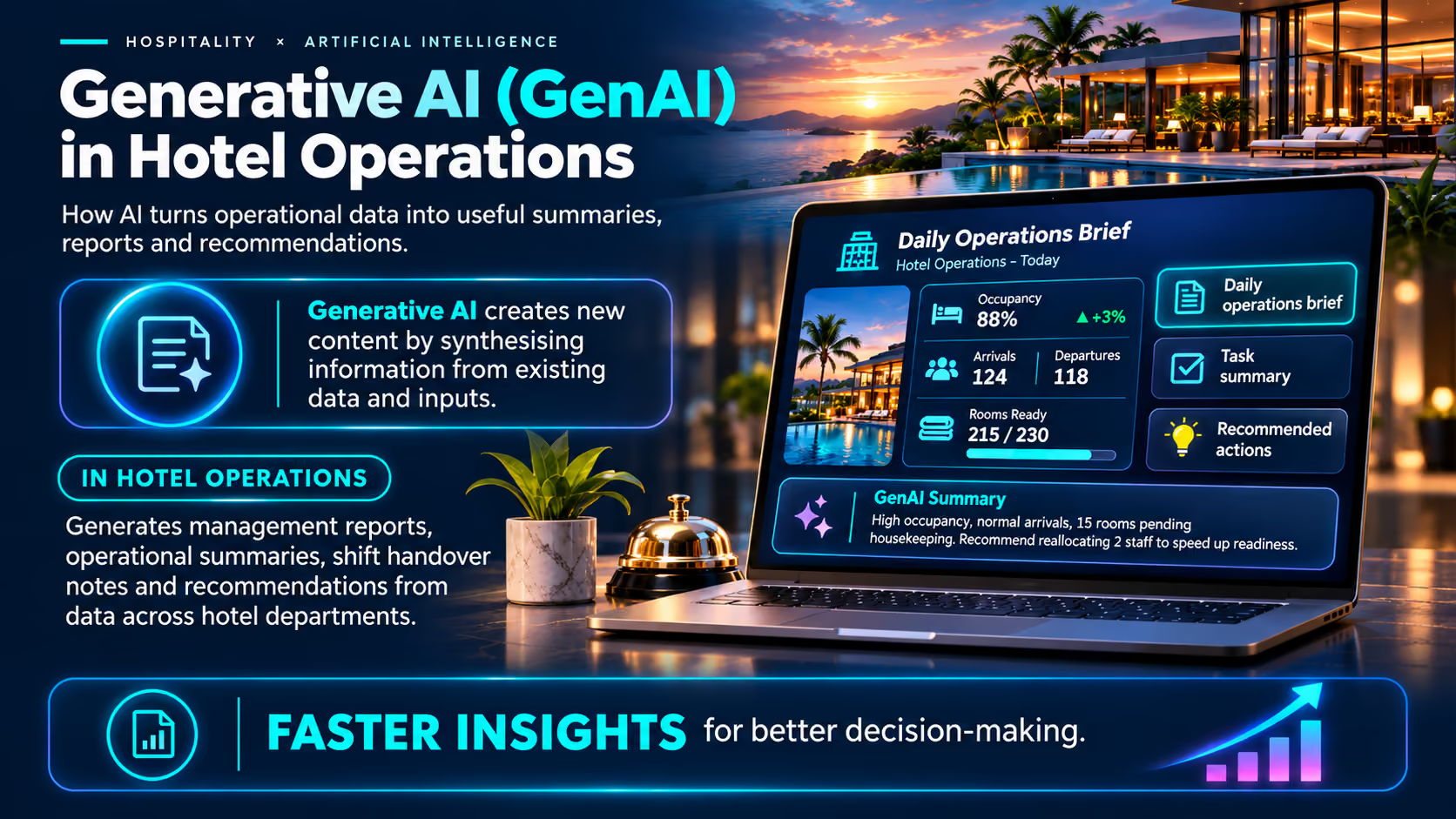
Hotels generate large amounts of operational information every day. Maintenance records, housekeeping updates, service requests, and departmental reports all contain information that managers need to review. Generative AI can help turn this information into summaries, reports and recommendations that are easier to understand and act on.
For example, instead of manually compiling updates from different departments, hotel managers could use GenAI to generate a daily operations report that includes outstanding tasks, recurring issues, and areas requiring attention.
This allows managers to spend less time consolidating information and more time reviewing priorities and coordinating their teams.
The accuracy of AI-generated information still matters, so staff should review important findings before making operational decisions.
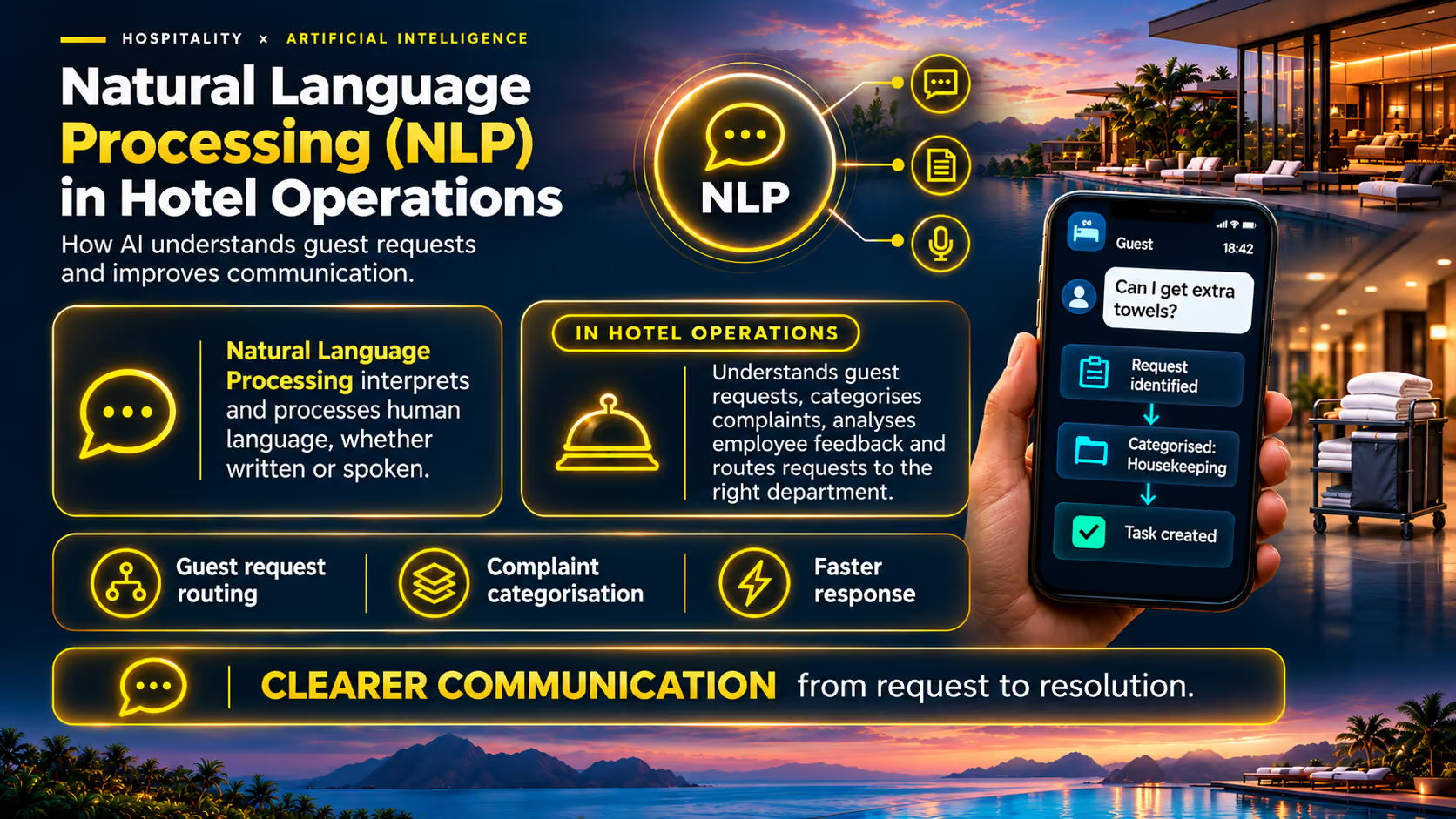
3. Natural Language Processing (NLP): Understanding Requests and Improving Communication
Guest requests come in many forms, from simple housekeeping needs to service complaints that require immediate attention. Natural Language Processing enables AI systems to interpret human language, identify the intent behind a message, and categorize information accordingly.
When a guest requests extra towels, for example, an NLP-enabled system can recognize the request, categorize it under housekeeping, and initiate the appropriate workflow.
The technology can also help analyze guest feedback, categorize complaints, and identify recurring service concerns.
By connecting what guests communicate with the operational tasks that follow, NLP can help hotels reduce manual processing and improve how requests are handled.
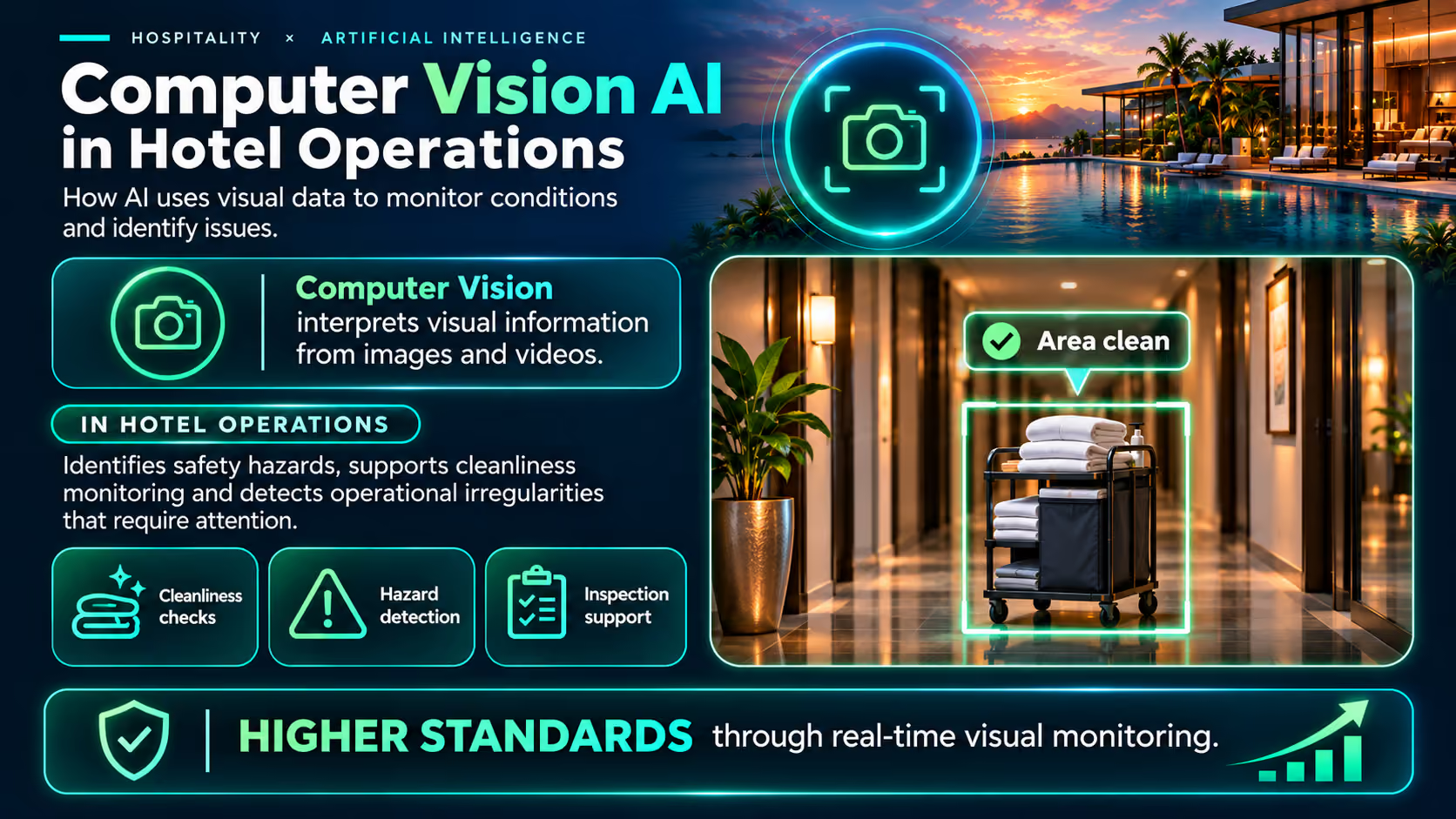
4. Computer Vision AI: Detecting Issues Through Visual Monitoring
Not every operational issue can be identified through reports or written requests. Some require visual observation, particularly when monitoring cleanliness, safety, and physical conditions across a property. Computer Vision allows AI systems to interpret information from images and videos, helping identify visible issues and irregularities.
In hotel operations, this could include detecting potential safety hazards in approved monitoring areas, flagging visible cleanliness concerns, or identifying conditions that require further inspection.
For housekeeping and operations teams, these capabilities can provide additional visibility into areas that need attention.
These capabilities must also be supported with appropriate privacy measures, reliable assessments, and human oversight, especially when guests and employees may be involved.
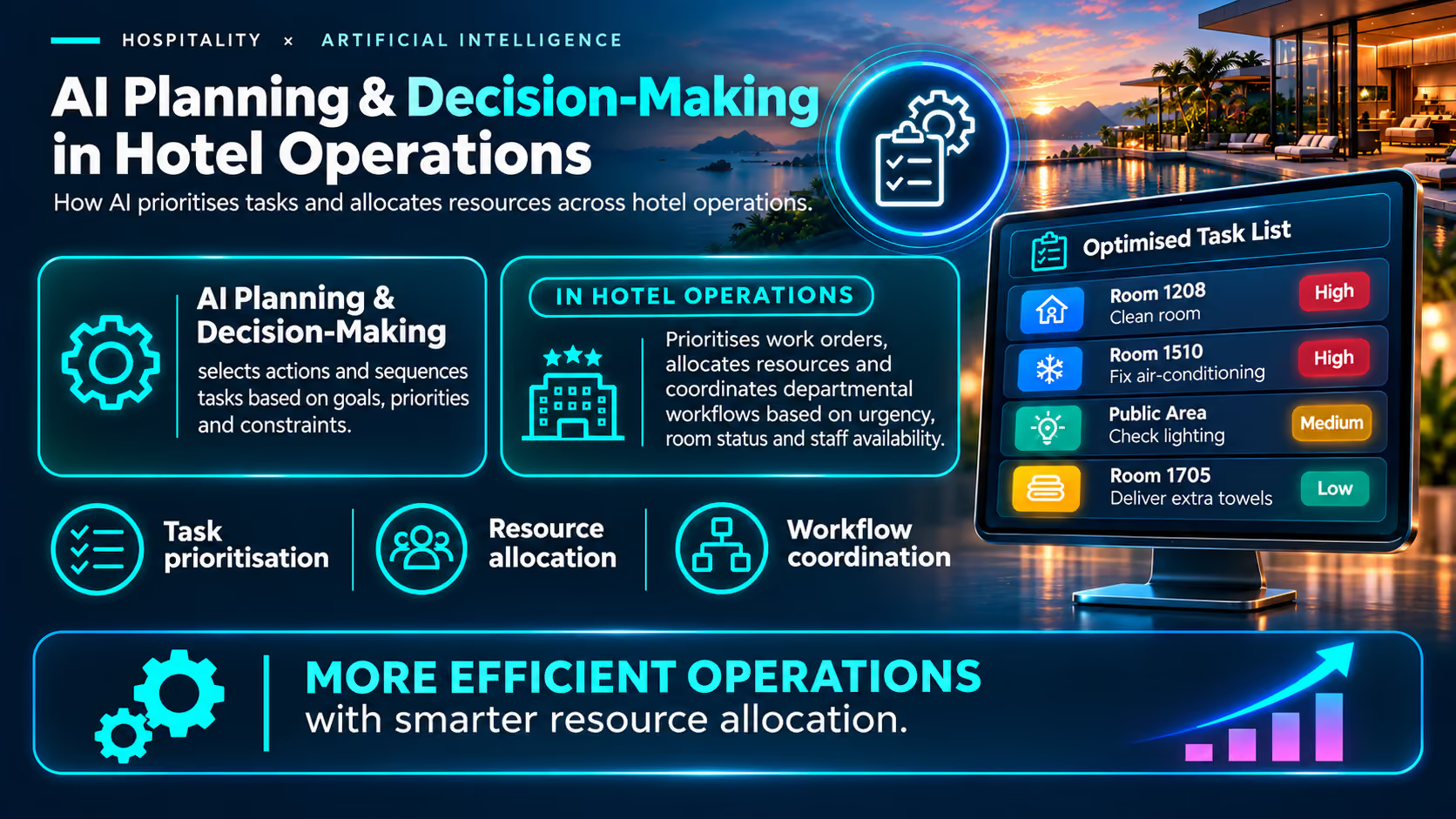
5. AI Planning & Decision-Making: Prioritizing Tasks and Allocating Resources
Hotel operations rarely follow a fixed schedule. A sudden maintenance issue, an urgent guest request, or an unexpected change in room readiness can quickly affect departmental priorities.
AI Planning & Decision-Making helps evaluate operational conditions and determine which actions should be prioritized based on available resources, objectives, and constraints. For example, an AI-enabled system could assess incoming housekeeping and maintenance requests, consider staff availability and task urgency, and recommend how tasks should be assigned.
Rather than relying entirely on manual coordination, hotel teams can use these recommendations to manage competing priorities and respond to changing operational needs. Depending on the system and its controls, some routine decisions may also be automated.
This creates opportunities for more efficient resource allocation and better coordination between departments.
Bringing AI Technologies Together in Hotel Operations
While these five AI technologies serve different functions, they can also work together to support a more coordinated operational workflow.
Consider a guest reporting an air-conditioning problem through a hotel service platform:
- Natural Language Processing could interpret the complaint and identify it as a maintenance request. AI Planning could then assess the urgency of the issue and recommend an appropriate task assignment.
- Machine Learning could analyze previous maintenance records to identify recurring faults involving similar equipment, while Generative AI could summarize the issue and relevant service history for the engineering team.
- Computer Vision could support other inspection activities where visual information is available and appropriate to use.
When these capabilities are connected to reliable operational data, hotels can gain a clearer understanding of current conditions and respond to potential problems more effectively.
Common Questions About AI in Hotel Operations
What are the five core AI technologies used in hotel operations?
The five technologies are Machine Learning, Generative AI, Natural Language Processing, Computer Vision AI, and AI Planning & Decision-Making. They support different functions, including predicting maintenance issues, generating operational reports, understanding guest requests, monitoring physical conditions, and coordinating departmental tasks.
How can AI help hotels predict maintenance issues?
Machine Learning can analyze equipment performance and historical maintenance records to identify recurring faults and patterns associated with potential failures. Engineering teams can use these findings to plan preventive maintenance and address problems before they cause unexpected disruptions.
Can AI automate hotel operations without human intervention?
Some AI-enabled systems can carry out routine tasks within predefined rules, while others provide recommendations for hotel staff to review and approve. The level of automation depends on the system, available data, and operational requirements. Human oversight remains important for verifying information, managing exceptions, and making decisions that affect guests and employees.
Moving Towards More Predictive Hotel Operations
The growing role of AI in hospitality is changing how operational decisions can be made.
Machine Learning helps identify patterns and predict potential issues. Generative AI makes operational information easier to use. Natural Language Processing improves how requests are understood, while Computer Vision provides additional ways to monitor physical conditions. AI Planning & Decision-Making helps teams organize tasks and allocate resources.
Together, these technologies create opportunities for hotels to move from reactive task management towards more predictive, data-driven operations.
For hotel operators, the next step is to identify where these capabilities can address existing operational challenges, whether that's reducing recurring maintenance problems, improving service response times, or coordinating resources more effectively.
The focus should remain on practical results: fewer disruptions, clearer communication, and better decisions that help hotel teams stay ahead of daily operational demands.
Featured posts

The next productivity gain may come from eliminating the manualwork that still exists between hotel technology systems.
The most expensive technology problem in a hotel may not be asystem that doesn’t work. It may be the employees who must work around it.
Hotels have spent years digitizing everything from housekeeping and maintenance to guest requests and room status, yet those systems don’t always communicate. Employees can still spend time making phone calls, sending messages and chasing down information to get the job done.
That creates a hidden cost for hotel owners: the labor required to connect operations. When operators are under pressure to control costs without compromising service, even small amounts of unnecessary communication and manual coordination can add up across hundreds of employees and thousands of daily tasks.
The issue is growing as hotels focus on productivity. HotelData.com’sQ1 2026 Labor Costs Report found that U.S. hotels reduced hours per occupied room by 2.3% year over year while labor cost per occupied room increased 1.8%. Housekeeping productivity also improved, with room-attendant minutes per occupied room down 4.3%.
Hotels are already finding ways to deploy their workforces more efficiently. The next opportunity may be examining how much labor is still consumed by coordinating work.
The work between the work
Consider a routine hotel interaction. A guest calls the front desk because something in the room isn’t working. An employee takes the request and determines which department should handle it. Someone in engineering receives the request, determines who is available and responds. Later, someone may need to confirm the problem was resolved while the front desk updates the guest.
The repair might take only a few minutes. The coordination surrounding it can take considerably longer.
The same dynamic plays out in housekeeping. A room attendant discovers a maintenance issue while servicing a room, but the information must reach engineering, the work must be assigned and completed, and the room’s status must be reflected accurately elsewhere in the operation.
These aren’t necessarily failures of individual employees. They are often failures of workflow.
Deloitte found that 45%of hotels surveyed said fragmented technology and data prevented them from achieving a single, end-to-end view of customers and operations. Roughly one-third cited integration with their existing technology stack as a concern.
When systems don’t communicate effectively, employees become theconnection between them. That creates what could be called the invisible labortax: the calls, messages, follow-ups and manual updates required to moveinformation from one part of the operation to another.
More technology isn’t necessarily the answer
That doesn’t mean hotels simply need to buy more technology. Adding another application to an already fragmented environment can create another layer of complexity if it doesn’t communicate with the systems employees already use.
The more important question is whether technology connects theoperation.
Can a guest request automatically reach the appropriate employee? Can a maintenance issue identified by housekeeping move directly into the engineering workflow? Can room status move between systems without requiring someone to enter the same information twice?
Those questions increasingly matter as hotels evaluate technology based on its ability to improve staff productivity and operational performance.
Connecting the operation
FCS Solutions has focused on connecting hotel operations for decades. The hospitality technology company has more than 40 years of industry experience and says more than 2,800 properties use its technology across more than 70 countries. Its FCS1 platform connects housekeeping, maintenance, guest services and incident management in a shared operational environment.
FCS says guest requests can be automatically routed, tracked and escalated, while maintenance issues identified by housekeeping can move directly into the maintenance workflow. Managers can see what is happening without calling individual departments for updates.
The platform is also designed to integrate with existing hoteltechnology, including property-management systems and third-party solutions,reducing manual data entry.
FCS reports that hotels using FCS1 can achieve up to 40% faster task response times and a 25% to 30% increase in housekeeping task efficiency. Those are company-reported figures rather than independent industry benchmarks, but they illustrate the productivity opportunity connected workflows can create.
Hotel customers describe the benefit in similar terms. Jennifer Rice Palmer, vice president of Guest Contact and Revenue Management at RosenHotels & Resorts, says FCS1 helps manage guest requests and maintenance tasks more precisely. At Caribe Royale Orlando, Phil Klinkenberg, Hotel Manager, says the platform improved efficiency and cross-departmental communication among housekeeping, engineering and the front office.
The common thread is what happens when employees no longer have to serve as the connection between separate parts of the operation.
Measuring the return
Instead of focusing only on system cost and features, owners can ask: How many employee minutes does it eliminate? How many calls and follow-ups disappear? How much faster does a guest request reach the employee who can solve it? How much quicker can a room move from dirty to inspected and available?
Those savings may seem small individually, but hotel operations arebuilt on repetition. A few minutes saved on one task becomes hours whenmultiplied across a department, a property and eventually a portfolio.
Hotels have demonstrated that they can improve labor productivity.The next opportunity is determining how much more productive that workforce could become if technology eliminated unnecessary communication and manual coordination between departments.
Because the hidden cost of disconnected hotel operations isn’t necessarily the technology itself. It is the labor required to work around it.
About the author
Rob Schneider is a freelance hotel investment journalist based in Texas whose work has recently appeared in Hospitality Investor, Hotel Management, Luxury Travel Advisor and Skift. He previously served as Managing Editor of Hotel InvestmentToday, a digital B2B media platform focused on the global hotel investment and hospitality real estate sector. He also previously worked at the DallasBusiness Journal and The Dallas Morning News.
This article has been published on:
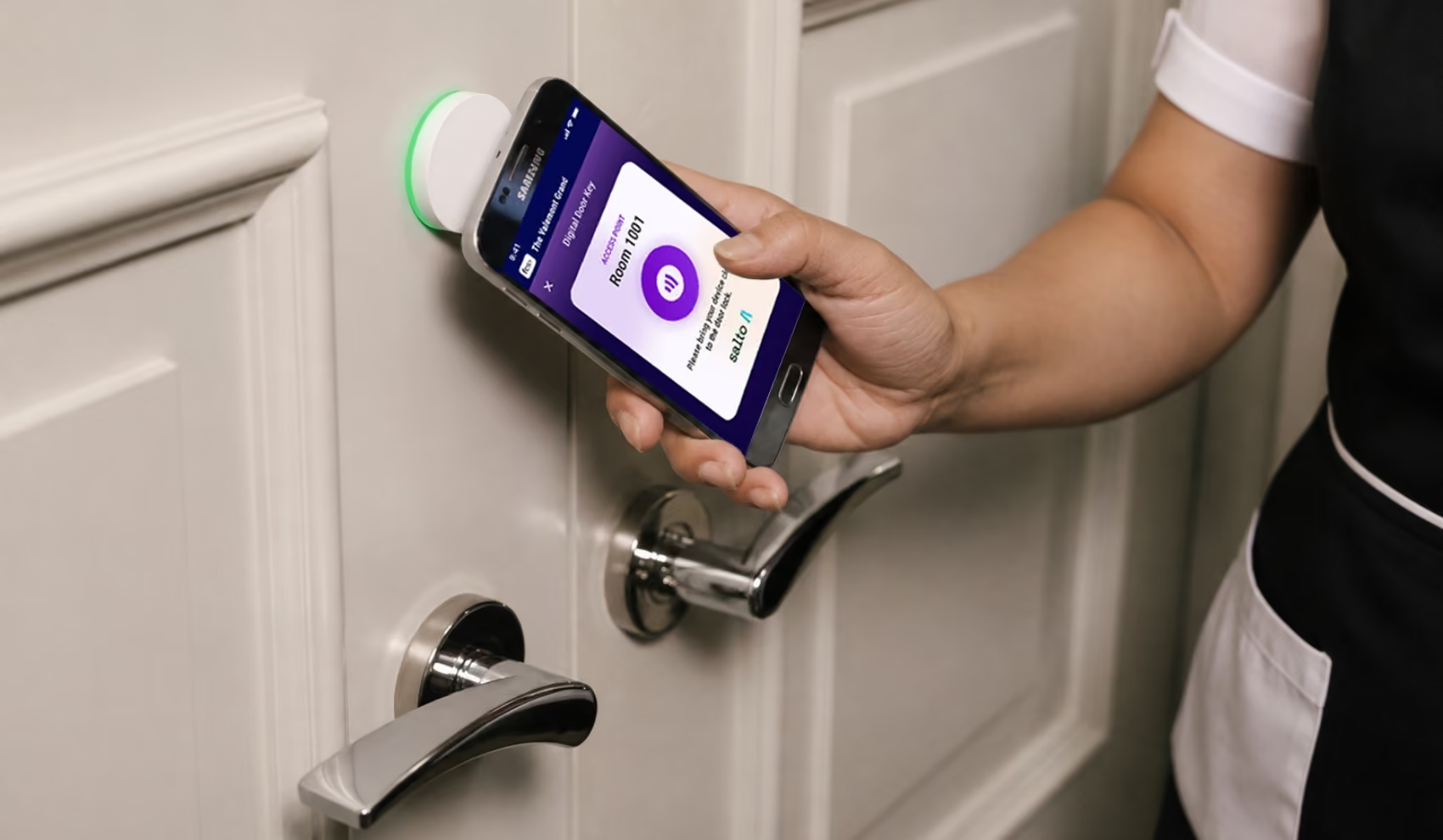
Equips housekeeping staff with secure mobile access, eliminating lost keys and access delays
FCS Solutions integrates its FCS1 platform with Salto's smart access control, letting room attendants unlock assigned guest rooms via mobile app and replacing master keys with a digital audit trail.
Singapore, 11 Aug 2026 - FCS Solutions, a cloud-native hospitality operations technology provider, today announced its integration with Salto, a global leader in smart access control solutions. The integration connects FCS1 Hospitality Operations Platform with the Salto Space smart access control platform, enabling hotels to digitize housekeeping operations through secure, keyless room access, enhancing hotel security, operational efficiency, and accountability.
With the integration, Room Attendants can unlock assigned guest rooms directly from the FCS1 mobile application after a Cleaning Order (CO) is initiated. Access is automatically authorised only for the assigned room and active task, ensuring staff can enter only the guest rooms they are scheduled to service. Replacing traditional master keys with secure digital access helps hotels maintain a clear audit trail of room access.
"Master keys are one of the last analog weak points in hotel security because they are difficult to track, easy to lose, and impossible to audit in real time," said Karen Bey, Vice President of Sales, FCS Solutions. "Our partnership with Salto closes that gap by giving hotel operators greater visibility and control over room access, with a clear record of who accessed which room and when."
"Access should be intelligent, secure and seamlessly integrated into daily hotel operations," said Winston Ng, Regional Manager, Strategic & Enterprise Accounts, Salto. "By partnering with FCS Solutions, we're extending that intelligence into one of the hospitality industry's most widely used operations workflows. A lock is no longer just a lock. It becomes part of a hotel's real-time operational ecosystem. Housekeeping teams gain faster, secure access, while operators benefit from the visibility, accountability, and audit trail that traditional master keys cannot provide.”
This collaboration reinforces FCS Solutions' commitment to an open hospitality platform connecting hotels with the partners and technologies that are shaping the future of hotel operations.
About FCS Solutions
FCS Solutions is a leading provider of hospitality technology, trusted by more than 2,800 properties across 71 countries to improve operational performance, staff productivity and guest satisfaction. Its flagship solution, FCS1, is a cloud-based hospitality operations platform that streamlines housekeeping, maintenance and guest services through intelligent automation, AI-powered capabilities, mobile workflows and real-time operational visibility. By connecting people, processes and technology on a single platform, FCS Solutions empowers hotels to operate more efficiently and deliver exceptional guest experiences.
CONNECT WITH FCS SOLUTIONS
WEBSITE | LINKEDIN | FACEBOOK | YOUTUBE
About Salto
Salto is a leading global access solutions provider, part of the SALTO WECOSYSTEM. We develop pioneering facility access, identity management and electronic locking technology that ensures seamless, reliable and secure experiences. Through close customer relationships and innovative solutions, our global team of experts create timeless and meaningful products that positively impact people and our planet.
CONNECT WITH SALTO SYSTEMS
In every era of hospitality, a single technology quietly transforms how hotels think, work, and connect with guests. The first Property Management Systems digitized reservations. Channel managers expanded reach. Mobile apps gave guests control at their fingertips. Now, a new frontier is emerging, driven by hotel business intelligence tools that go beyond automation. Artificial Intelligence is no longer just an assistant to humans. It is becoming a co-operator that thinks, adapts, and acts alongside them. We are entering the age of cognitive hospitality.
From Reactive Operations to Predictive Intelligence
Today, most hotels still operate reactively, responding to guest requests, occupancy changes, or service gaps. But the next evolution will be guided by hotel business intelligence software that predicts needs before they even appear. Imagine your property’s digital systems like PMS, housekeeping, maintenance, CRM, all feeding data into one unified intelligence. It can recognize early check-in patterns, forecast service bottlenecks, and allocate staff automatically based on what’s happening in real time. In this near future, a housekeeping system doesn’t just schedule cleaning rounds; it senses when rooms are ready through motion, temperature, and guest device signals. Maintenance no longer waits for a service ticket. It detects unusual vibration patterns in the HVAC system and creates a task before anyone calls. The hotel of tomorrow will not just run faster. It will run smarter, continuously learning from its own rhythm and data patterns.

Where Conversations Become Commerce
The guest journey is turning into a continuous conversation. Instead of scrolling through websites or apps, travelers will simply tell their digital assistants what they want, and those assistants will handle everything.
“Find me a resort in Kyoto with private onsen villas, a mountain view, and electric vehicle pickup.”
“Book me a three-night stay in Paris near the Louvre with a large workspace and late checkout.”
In seconds, the system compares live inventories, reviews, and prices, completes the booking, processes payment, and even pre-selects preferred amenities. Guests may never touch an OTA or open a browser again. The entire transaction could happen through a single exchange between two digital assistants, the traveler’s and your hotel’s AI-powered system. This is already becoming real. Stripe’s Agentic Commerce allows AI agents to handle payments securely, while conversational systems like PolyAI are learning to speak the language of hospitality naturally and intelligently. For hotels, the next booking engine might not be a webpage. It could be a smart hotel system that knows when a traveler is ready to book.
The Rebirth of the Concierge
As hotel business intelligence tools and automation handle routine work, the human role will shift from transactional to emotional. Front-desk teams will no longer be valued for speed, but for empathy, and for noticing small cues, handling recovery moments, and adding human warmth where technology cannot. The AI concierge will take care of confirmations, reminders, and upgrades. The human concierge will become the storyteller, curating experiences that make every stay memorable. We will no longer train staff to follow steps. We will train them to design moments.
Data: The New Language of Hospitality
AI thrives on clarity, not just volume. In tomorrow’s hospitality landscape, your property’s visibility will depend on how well your data can be read, understood, and trusted by hotel business intelligence tools. Every room description, amenity tag, and review becomes a digital signal. Hotels that organize their data properly like linking services, locations, sustainability, and experience details, will appear more naturally in AI-powered searches and travel planning tools. Your ranking will not only live on a website anymore. It will be decided in a conversation between two intelligent systems that understand which hotel truly fits a traveler’s intent.

Hospitality Intelligence: Beyond Automation
Real transformation begins when technology becomes a collaborator rather than just a helper. This is where hospitality data intelligence takes center stage. AI and analytics will blend data, timing, and emotion into a learning system that helps your hotel:
- Predict occupancy and staffing needs before demand rises
- Detect guest emotions through voice and behavior in real time
- Adjust pricing dynamically based on market context and guest sentiment
- Recommend sustainability actions that improve efficiency and reduce waste
When every department, from housekeeping to CRM, becomes part of one connected network, the hotel evolves into a living system powered by hotel business intelligence software. It starts to feel the rhythm of its guests and respond with precision.
Redefining What It Means to Be Human in Hospitality
This future doesn’t remove the human touch in hospitality; it enhances it. Teams will have more time for empathy, creativity, and genuine connection, the parts of service that can’t be coded. Leaders such as General Managers and Directors of Operations will no longer just manage performance metrics. They will design intelligence itself, deciding how systems think and what values they optimize for. The real question for tomorrow’s hoteliers isn’t “How do we use AI?” but “How do we teach it to understand what makes hospitality human?” Imagine a stay where your hotel already knows you but still manages to surprise you. Your favorite cookie is waiting in the room. The temperature, pillow firmness, and music are just the way you like them.
The age of cognitive hospitality and hotel business intelligence is here. The question isn’t when it arrives. It’s whether your hotel is ready to think.