


.svg)
How FCS1 IRGS connects the in-room guest experience with hotel operations

Sponsored content. This article is part of a paid editorial. Hotel Tech News retained editorial control over the framing, the market data and the analysis. View the article on hoteltech.news here.
Quick Answer:FCS1 In-Room Guest Services (IRGS) is the guest-facing module of FCS1, launched on 25 August 2026. A guest scans a QR code and requests hotel services from their own phone, with no app to download, and each request flows into FCS1 Jobs so the right department can fulfil, escalate and track it.
In short
- FCS1 IRGS launched on 25 August 2026 as the guest-facing module of FCS1, not a standalone product.
- Guests scan a QR code and request services from their own phone in the browser, with no app to download.
- Every request lands in FCS1 Jobs, is routed to the department that fulfils it, and is tracked to completion.
- It covers guest requests, in-room dining, laundry and hotel facilities, with a self-service portal for the hotel.
- No customer results are published yet: FCS claims outcomes such as fewer missed requests and fewer handovers, not percentages.
The gap is not the request, it is the fulfilment
A guest asking for something is the easy part. The hard part is what happens next: the request reaching the right team and closing without anyone chasing it. That gap is where hotel service quietly breaks.
It breaks more often when a property is short-staffed. When we profiled FCS Solutions we opened on the number that frames the whole sector: European hospitality is running roughly 10% short of the workforce it needs. A smaller team covering more rooms cannot afford calls that get missed at check-in rush, handovers scribbled on paper, or an order that never reaches the kitchen.
FCS1 IRGS is FCS's answer to that specific gap. It is not a guest app and it is not a digital directory. It is the point where a guest asks for something and the operational team responsible for delivering it picks it up.
What a request looks like from the inside
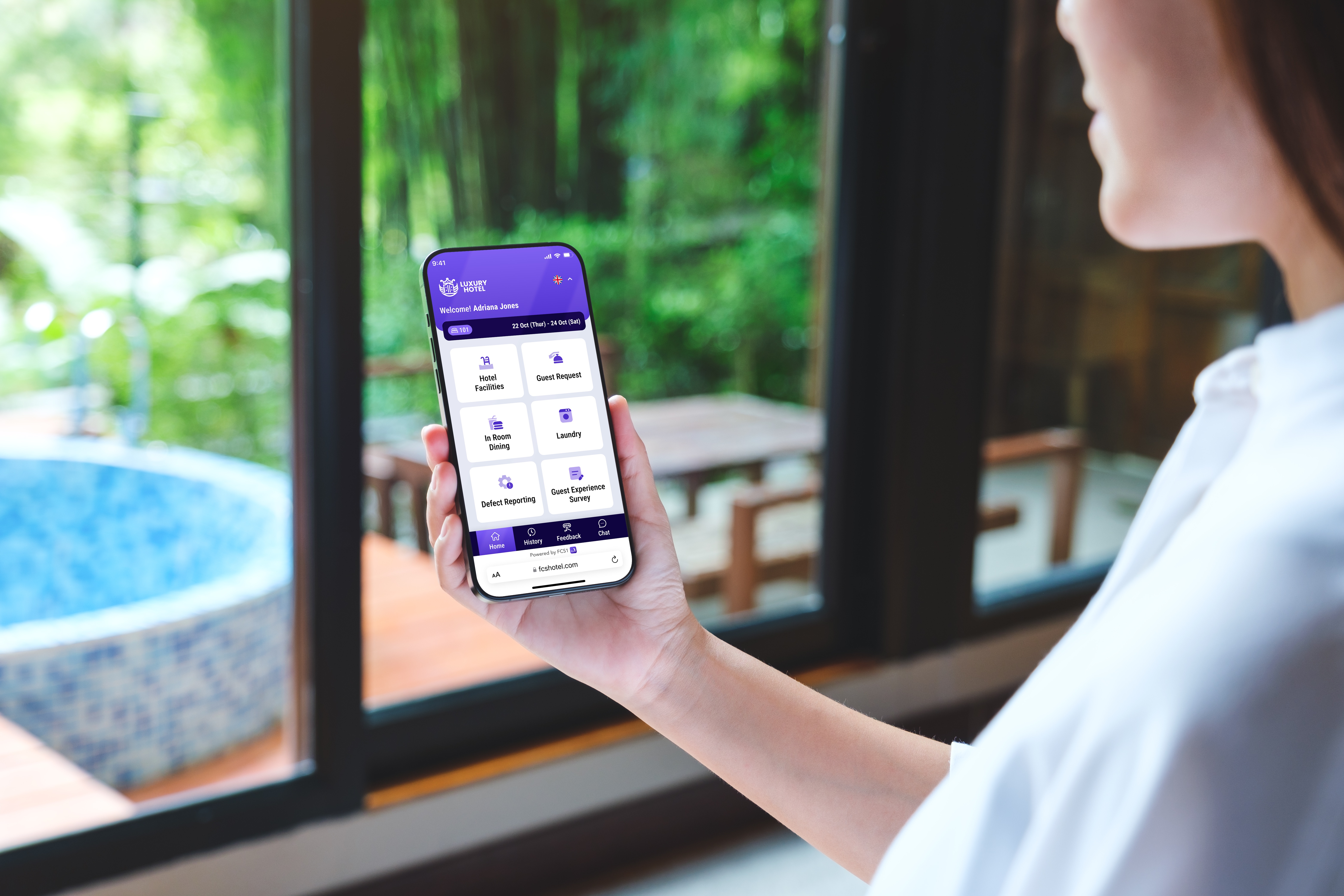
The guest side is deliberately plain. Scan a QR code, the browser opens, browse the hotel or pick a service, submit. No download, no account.
What matters is the second half, the part the guest never sees:
The guest does thisIt becomes this inside the hotelRequests an amenity or reports an issueA job routed to the right operational teamOrders in-room diningAn order routed straight to F&BBooks laundry or dry cleaningA submitted order, tracked to completionLooks up facilities, hours and locationsSelf-service info the hotel keeps current
Every one of those submissions lands in FCS1 Jobs, the workflow engine underneath. From there it is routed, worked and tracked from initiation through to fulfilment, with the status visible to the teams and managers who need it.
It is part of FCS1, not a bolt-on
This is the positioning FCS is most deliberate about, and it is the reason IRGS is more than a menu. IRGS is a module of the FCS1 platform, and FCS1 Jobs must be enabled for its request features to work. The guest-facing layer and the operational layer are the same system, not two tools stitched together.
That continuity is the through-line from the platform we covered before: FCS1 already connects housekeeping, maintenance, incidents and guest services for complex hotels. IRGS extends that same connected workflow all the way to the guest's own phone.
What the platform underneath looks like
FCS1 IRGS inherits the FCS1 platform's shape: cloud-based, API-first, cross-platform, fully customisable, multi-language, and supported by FCS around the clock. Guests reach it through the browser on their own devices, so there is no guest app to install or maintain. Hotels keep their own information current through a self-service content management portal, without going back to a vendor for every menu change.
What FCS is claiming, and what it is not
Worth being precise here, because FCS is. At launch there is no named customer and no published performance data, so there are no numbers to quote on response time, productivity or guest satisfaction. What FCS does stand behind are operational outcomes: fewer missed requests, fewer manual handovers, less reliance on calls to the front desk, more efficient routing, and clearer visibility of where each request stands.
Karen Bey, Vice President of Sales at FCS Solutions, framed the launch this way:
"FCS has long focused on helping hotels optimise operational workflows and improve staff productivity. FCS1 IRGS extends that capability by making it simple for guests to ask for what they need. By connecting each request directly to hotel operations, hotels can reduce missed requests and provide faster, more consistent service."
Our take
The interesting part of IRGS is not the guest menu, which every guest-facing tool has. It is that the menu is wired to the operations platform behind it, so a request does not have to be re-entered, relayed or remembered by a person. For a short-staffed hotel, removing that handover is worth more than another app.
For a hotel weighing it up, the useful questions are about the whole path, not the front screen. How does a request travel from the guest to the person who closes it. What happens when the assigned team is busy. Which languages does the guest side support. And how is it run day to day through FCS1 Jobs. Ask those first.
Where to see it
FCS published FCS1 IRGS on 25 August 2026 (launch announcement). The official product page is FCS1 In-Room Guest Services, and it sits inside the broader FCS1 platform. For the wider picture of how FCS runs hotel operations, see our earlier profile, FCS Solutions: one operations platform for the most complex hotels.
Featured posts

The next productivity gain may come from eliminating the manualwork that still exists between hotel technology systems.
The most expensive technology problem in a hotel may not be asystem that doesn’t work. It may be the employees who must work around it.
Hotels have spent years digitizing everything from housekeeping and maintenance to guest requests and room status, yet those systems don’t always communicate. Employees can still spend time making phone calls, sending messages and chasing down information to get the job done.
That creates a hidden cost for hotel owners: the labor required to connect operations. When operators are under pressure to control costs without compromising service, even small amounts of unnecessary communication and manual coordination can add up across hundreds of employees and thousands of daily tasks.
The issue is growing as hotels focus on productivity. HotelData.com’sQ1 2026 Labor Costs Report found that U.S. hotels reduced hours per occupied room by 2.3% year over year while labor cost per occupied room increased 1.8%. Housekeeping productivity also improved, with room-attendant minutes per occupied room down 4.3%.
Hotels are already finding ways to deploy their workforces more efficiently. The next opportunity may be examining how much labor is still consumed by coordinating work.
The work between the work
Consider a routine hotel interaction. A guest calls the front desk because something in the room isn’t working. An employee takes the request and determines which department should handle it. Someone in engineering receives the request, determines who is available and responds. Later, someone may need to confirm the problem was resolved while the front desk updates the guest.
The repair might take only a few minutes. The coordination surrounding it can take considerably longer.
The same dynamic plays out in housekeeping. A room attendant discovers a maintenance issue while servicing a room, but the information must reach engineering, the work must be assigned and completed, and the room’s status must be reflected accurately elsewhere in the operation.
These aren’t necessarily failures of individual employees. They are often failures of workflow.
Deloitte found that 45%of hotels surveyed said fragmented technology and data prevented them from achieving a single, end-to-end view of customers and operations. Roughly one-third cited integration with their existing technology stack as a concern.
When systems don’t communicate effectively, employees become theconnection between them. That creates what could be called the invisible labortax: the calls, messages, follow-ups and manual updates required to moveinformation from one part of the operation to another.
More technology isn’t necessarily the answer
That doesn’t mean hotels simply need to buy more technology. Adding another application to an already fragmented environment can create another layer of complexity if it doesn’t communicate with the systems employees already use.
The more important question is whether technology connects theoperation.
Can a guest request automatically reach the appropriate employee? Can a maintenance issue identified by housekeeping move directly into the engineering workflow? Can room status move between systems without requiring someone to enter the same information twice?
Those questions increasingly matter as hotels evaluate technology based on its ability to improve staff productivity and operational performance.
Connecting the operation
FCS Solutions has focused on connecting hotel operations for decades. The hospitality technology company has more than 40 years of industry experience and says more than 2,800 properties use its technology across more than 70 countries. Its FCS1 platform connects housekeeping, maintenance, guest services and incident management in a shared operational environment.
FCS says guest requests can be automatically routed, tracked and escalated, while maintenance issues identified by housekeeping can move directly into the maintenance workflow. Managers can see what is happening without calling individual departments for updates.
The platform is also designed to integrate with existing hoteltechnology, including property-management systems and third-party solutions,reducing manual data entry.
FCS reports that hotels using FCS1 can achieve up to 40% faster task response times and a 25% to 30% increase in housekeeping task efficiency. Those are company-reported figures rather than independent industry benchmarks, but they illustrate the productivity opportunity connected workflows can create.
Hotel customers describe the benefit in similar terms. Jennifer Rice Palmer, vice president of Guest Contact and Revenue Management at RosenHotels & Resorts, says FCS1 helps manage guest requests and maintenance tasks more precisely. At Caribe Royale Orlando, Phil Klinkenberg, Hotel Manager, says the platform improved efficiency and cross-departmental communication among housekeeping, engineering and the front office.
The common thread is what happens when employees no longer have to serve as the connection between separate parts of the operation.
Measuring the return
Instead of focusing only on system cost and features, owners can ask: How many employee minutes does it eliminate? How many calls and follow-ups disappear? How much faster does a guest request reach the employee who can solve it? How much quicker can a room move from dirty to inspected and available?
Those savings may seem small individually, but hotel operations arebuilt on repetition. A few minutes saved on one task becomes hours whenmultiplied across a department, a property and eventually a portfolio.
Hotels have demonstrated that they can improve labor productivity.The next opportunity is determining how much more productive that workforce could become if technology eliminated unnecessary communication and manual coordination between departments.
Because the hidden cost of disconnected hotel operations isn’t necessarily the technology itself. It is the labor required to work around it.
About the author
Rob Schneider is a freelance hotel investment journalist based in Texas whose work has recently appeared in Hospitality Investor, Hotel Management, Luxury Travel Advisor and Skift. He previously served as Managing Editor of Hotel InvestmentToday, a digital B2B media platform focused on the global hotel investment and hospitality real estate sector. He also previously worked at the DallasBusiness Journal and The Dallas Morning News.
This article is also published on HospitalityNet. View the article here.
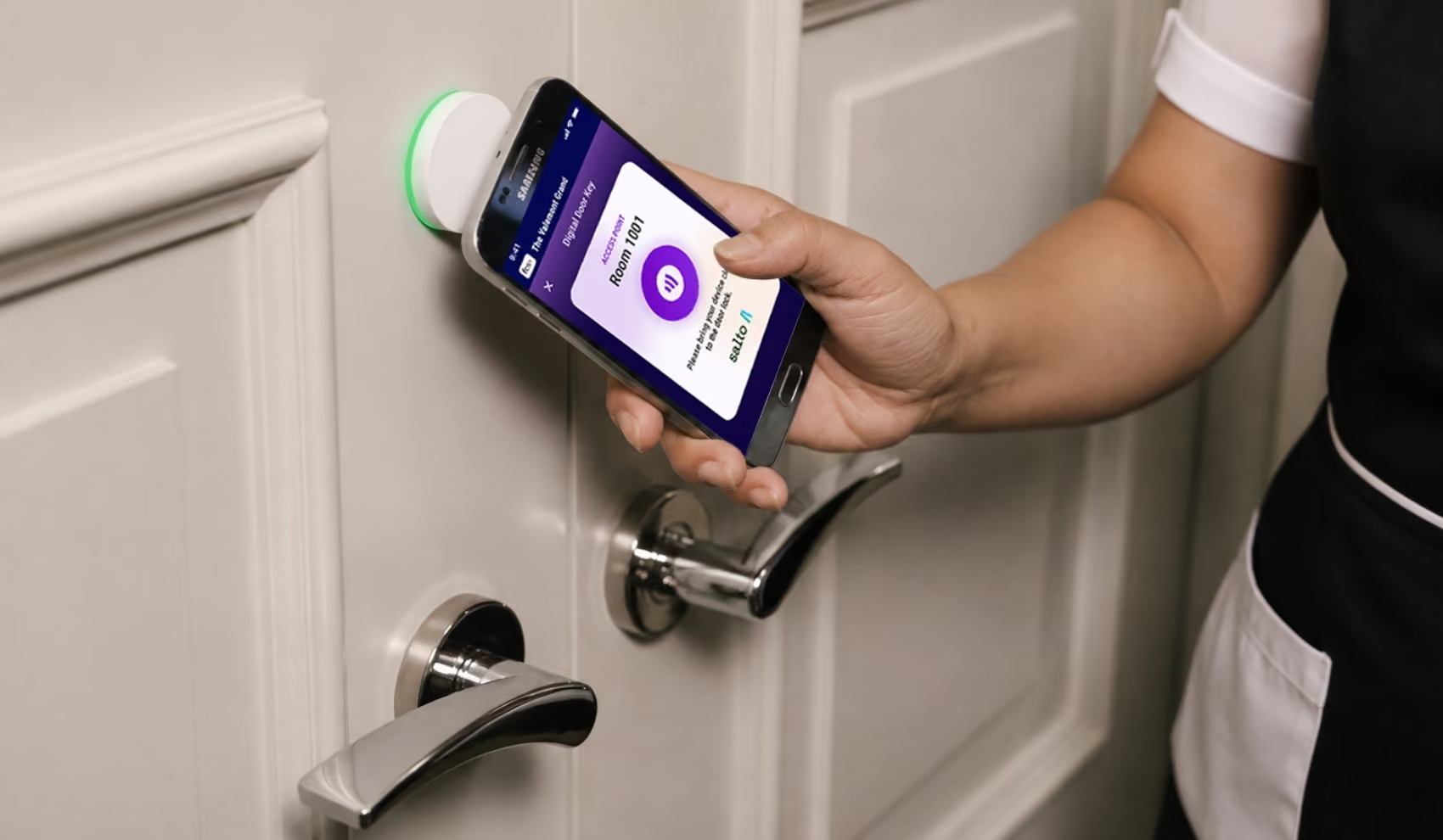
Equips housekeeping staff with secure mobile access, eliminating lost keys and access delays
FCS Solutions integrates its FCS1 platform with Salto's smart access control, letting room attendants unlock assigned guest rooms via mobile app and replacing master keys with a digital audit trail.
Singapore, 11 Aug 2026 - FCS Solutions, a cloud-native hospitality operations technology provider, today announced its integration with Salto, a global leader in smart access control solutions. The integration connects FCS1 Hospitality Operations Platform with the Salto Space smart access control platform, enabling hotels to digitize housekeeping operations through secure, keyless room access, enhancing hotel security, operational efficiency, and accountability.
With the integration, Room Attendants can unlock assigned guest rooms directly from the FCS1 mobile application after a Cleaning Order (CO) is initiated. Access is automatically authorised only for the assigned room and active task, ensuring staff can enter only the guest rooms they are scheduled to service. Replacing traditional master keys with secure digital access helps hotels maintain a clear audit trail of room access.
"Master keys are one of the last analog weak points in hotel security because they are difficult to track, easy to lose, and impossible to audit in real time," said Karen Bey, Vice President of Sales, FCS Solutions. "Our partnership with Salto closes that gap by giving hotel operators greater visibility and control over room access, with a clear record of who accessed which room and when."
"Access should be intelligent, secure and seamlessly integrated into daily hotel operations," said Winston Ng, Regional Manager, Strategic & Enterprise Accounts, Salto. "By partnering with FCS Solutions, we're extending that intelligence into one of the hospitality industry's most widely used operations workflows. A lock is no longer just a lock. It becomes part of a hotel's real-time operational ecosystem. Housekeeping teams gain faster, secure access, while operators benefit from the visibility, accountability, and audit trail that traditional master keys cannot provide.”
This collaboration reinforces FCS Solutions' commitment to an open hospitality platform connecting hotels with the partners and technologies that are shaping the future of hotel operations.
About FCS Solutions
FCS Solutions is a leading provider of hospitality technology, trusted by more than 2,800 properties across 71 countries to improve operational performance, staff productivity and guest satisfaction. Its flagship solution, FCS1, is a cloud-based hospitality operations platform that streamlines housekeeping, maintenance and guest services through intelligent automation, AI-powered capabilities, mobile workflows and real-time operational visibility. By connecting people, processes and technology on a single platform, FCS Solutions empowers hotels to operate more efficiently and deliver exceptional guest experiences.
CONNECT WITH FCS SOLUTIONS
WEBSITE | LINKEDIN | FACEBOOK | YOUTUBE
About Salto
Salto is a leading global access solutions provider, part of the SALTO WECOSYSTEM. We develop pioneering facility access, identity management and electronic locking technology that ensures seamless, reliable and secure experiences. Through close customer relationships and innovative solutions, our global team of experts create timeless and meaningful products that positively impact people and our planet.
CONNECT WITH SALTO SYSTEMS
In every era of hospitality, a single technology quietly transforms how hotels think, work, and connect with guests. The first Property Management Systems digitized reservations. Channel managers expanded reach. Mobile apps gave guests control at their fingertips. Now, a new frontier is emerging, driven by hotel business intelligence tools that go beyond automation. Artificial Intelligence is no longer just an assistant to humans. It is becoming a co-operator that thinks, adapts, and acts alongside them. We are entering the age of cognitive hospitality.
From Reactive Operations to Predictive Intelligence
Today, most hotels still operate reactively, responding to guest requests, occupancy changes, or service gaps. But the next evolution will be guided by hotel business intelligence software that predicts needs before they even appear. Imagine your property’s digital systems like PMS, housekeeping, maintenance, CRM, all feeding data into one unified intelligence. It can recognize early check-in patterns, forecast service bottlenecks, and allocate staff automatically based on what’s happening in real time. In this near future, a housekeeping system doesn’t just schedule cleaning rounds; it senses when rooms are ready through motion, temperature, and guest device signals. Maintenance no longer waits for a service ticket. It detects unusual vibration patterns in the HVAC system and creates a task before anyone calls. The hotel of tomorrow will not just run faster. It will run smarter, continuously learning from its own rhythm and data patterns.

Where Conversations Become Commerce
The guest journey is turning into a continuous conversation. Instead of scrolling through websites or apps, travelers will simply tell their digital assistants what they want, and those assistants will handle everything.
“Find me a resort in Kyoto with private onsen villas, a mountain view, and electric vehicle pickup.”
“Book me a three-night stay in Paris near the Louvre with a large workspace and late checkout.”
In seconds, the system compares live inventories, reviews, and prices, completes the booking, processes payment, and even pre-selects preferred amenities. Guests may never touch an OTA or open a browser again. The entire transaction could happen through a single exchange between two digital assistants, the traveler’s and your hotel’s AI-powered system. This is already becoming real. Stripe’s Agentic Commerce allows AI agents to handle payments securely, while conversational systems like PolyAI are learning to speak the language of hospitality naturally and intelligently. For hotels, the next booking engine might not be a webpage. It could be a smart hotel system that knows when a traveler is ready to book.
The Rebirth of the Concierge
As hotel business intelligence tools and automation handle routine work, the human role will shift from transactional to emotional. Front-desk teams will no longer be valued for speed, but for empathy, and for noticing small cues, handling recovery moments, and adding human warmth where technology cannot. The AI concierge will take care of confirmations, reminders, and upgrades. The human concierge will become the storyteller, curating experiences that make every stay memorable. We will no longer train staff to follow steps. We will train them to design moments.
Data: The New Language of Hospitality
AI thrives on clarity, not just volume. In tomorrow’s hospitality landscape, your property’s visibility will depend on how well your data can be read, understood, and trusted by hotel business intelligence tools. Every room description, amenity tag, and review becomes a digital signal. Hotels that organize their data properly like linking services, locations, sustainability, and experience details, will appear more naturally in AI-powered searches and travel planning tools. Your ranking will not only live on a website anymore. It will be decided in a conversation between two intelligent systems that understand which hotel truly fits a traveler’s intent.

Hospitality Intelligence: Beyond Automation
Real transformation begins when technology becomes a collaborator rather than just a helper. This is where hospitality data intelligence takes center stage. AI and analytics will blend data, timing, and emotion into a learning system that helps your hotel:
- Predict occupancy and staffing needs before demand rises
- Detect guest emotions through voice and behavior in real time
- Adjust pricing dynamically based on market context and guest sentiment
- Recommend sustainability actions that improve efficiency and reduce waste
When every department, from housekeeping to CRM, becomes part of one connected network, the hotel evolves into a living system powered by hotel business intelligence software. It starts to feel the rhythm of its guests and respond with precision.
Redefining What It Means to Be Human in Hospitality
This future doesn’t remove the human touch in hospitality; it enhances it. Teams will have more time for empathy, creativity, and genuine connection, the parts of service that can’t be coded. Leaders such as General Managers and Directors of Operations will no longer just manage performance metrics. They will design intelligence itself, deciding how systems think and what values they optimize for. The real question for tomorrow’s hoteliers isn’t “How do we use AI?” but “How do we teach it to understand what makes hospitality human?” Imagine a stay where your hotel already knows you but still manages to surprise you. Your favorite cookie is waiting in the room. The temperature, pillow firmness, and music are just the way you like them.
The age of cognitive hospitality and hotel business intelligence is here. The question isn’t when it arrives. It’s whether your hotel is ready to think.



.png)


